
The interview is not where you discover your gaps. My Next Hop helps you find and fix them first.
The gap is not knowledge. It is never having had to explain your thinking out loud — to someone who pushes back until every edge case surfaces. That is what My Next Hop trains — for network, cloud, and infrastructure engineers targeting Amazon, Google, Meta, Microsoft, Cloudflare, and Anthropic.
Over 3,200 questions across 83 topics — Foundations through L7 — including 150+ topology-backed diagram questions that test whether you can trace the packet path, not just recall the definition.
Or try one question on WhatsApp — no signup →The namespace has a default-deny NetworkPolicy. After adding an ingress allow rule for the ingress controller, /jobs requests still fail. What is the most likely gap in the policy?
After attaching VPC-SharedSvcs to this Transit Gateway, Production VPC can no longer reach on-premises — and no route table entries changed. What is the most likely cause?
After PE-1 advertises a prefix to RR-1, which clients in this cluster will receive the reflected route — and what attribute prevents it from looping back to PE-1?
One of 100+ topology-backed questions across BGP, VPC, Kubernetes & optical transport
Zero signup required
Try a real interview question — on WhatsApp, right now.
Text Betty your target role and level. She'll ask one real interview question, then give you honest, specific feedback — no app, no account, no card. Takes about two minutes.
Scan on your phone
See it, don't just take our word for it
What you actually get back.
Illustrative examples built from one real question in the bank — BGP path selection — following the actual loop: Betty probes what you said live, the scorecard grades it, and a flashcard locks in the exact gap. Not a real user's submission.
Betty follow-up
Example outputProbing what you actually said — not a scripted next question

Scorecard
Example output“Walk me through BGP path selection” · L5 · Amazon
Strength: Got the first three tiebreakers in the right order — weight, local preference, AS_PATH length — which most candidates mix up.
Gap: Stopped at AS_PATH length — didn't reach origin type, MED, or router ID, which a senior panel at Amazon would probe for.
Highest-leverage fix: Tie the AS_PATH tiebreak to how you'd actually use prepending for traffic engineering — the difference between reciting the order and showing you've operated it.
Flashcard
Example outputGenerated from the gap above — not a generic deck
Why isn't AS_PATH length the final tiebreak in BGP path selection?
Definition: Origin type, MED, and router ID are all evaluated after AS_PATH length when two paths are still tied — in that order.
Why it exists: Two paths can share AS_PATH length but differ in real cost — MED lets a neighboring AS signal its own preference.
Watch out: By default, routers only compare MED between routes learned from the same neighboring AS — across different neighbors, it isn't even in play.
···plus mechanism, example, and interview-framing sections in the full card.
This is what every single drill gives you back.
Free to start — no card required, 3 drills a day on the house.
Why My Next Hop
ChatGPT knows the answer. My Next Hop trains the performance.
You can ask ChatGPT any question in this bank and get a correct answer. The gap is never information. It is the ability to produce that answer under pressure, out loud, in real time — and to know whether you are actually improving. That is what My Next Hop is built for.
If you're using
What it can't do
My Next Hop does this instead
Ask you to explain it. Recognition is not performance — knowing what BGP route reflectors do and being able to explain it clearly under follow-up are different skills.
Drills you by voice or text. Scores every answer on a real rubric. Asks follow-up questions. Tells you exactly what was missing — before a real panel does.
Give you answers. There is no scoring, no delivery tracking, no mastery model, no company calibration, and no concept of what you missed last session. You hear what a good answer sounds like — you do not produce one.
9 speech delivery metrics. Interview rubric built for six company processes — Amazon, Google, Meta, Microsoft, Cloudflare, and Anthropic — modeled from published hiring frameworks and engineering community reports. Mastery score per topic that fades if you stop practicing, so 'ready' stays honest. Readiness score 0–100. Concept prerequisites enforce the learning order, visualized on your Learning Path. Questions ranked by what you haven't answered, each topic's current mastery, and your interview stage — never served at random.
Test recall. Flipping a card proves you recognised the answer. It does not prove you can explain it out loud to someone who keeps asking until the edge cases surface.
SM-2 spaced repetition for retention — but the main event is producing answers by voice, under follow-up, against the bar your target company actually sets.
General CS focus, no speech metrics, no progression tracking, no network specialisation, and availability depends on when your peer is free.
Network-specific. Built for the depth that network engineering panels actually test. Available every day. Tracks mastery per topic across every session and tells you when you are ready to schedule the real thing.
One hour a week, $150–500 per session, no tracking between sessions, rarely specialised in network engineering at your specific target company and level.
Available every day. Built for six company interview processes — the behavioral competencies, level expectations, and depth signals that panels use, modeled from published hiring frameworks and engineering community reports. A fraction of the cost.
And the difference compounds. Every answer updates your mastery map, your speech trends, and your readiness score — so tomorrow's practice targets exactly what today exposed. A fresh chat window starts from zero every time. My Next Hop never does.
The real problem
You are not under-qualified. You are under-practised.
Knowing something and being able to perform it under live questioning are different skills. One comes from studying. The other only comes from reps — answering, defending, and being pushed until the explanation is automatic, in the shape a panel is trained to recognise as strong.
The senior engineer
You know what a BGP route leak looks like. You have shipped real infrastructure. But when the design review pauses and the room turns to you, the words do not come as fast as they should. Depth that is not exercised goes cold — and cold depth does not show up when it counts.
The candidate
You understand the material. But there is a gap between knowing a protocol and explaining it clearly to someone who keeps asking until the edge cases surface. That gap does not close by studying more. It closes by practising under pressure.
The technically correct candidate
You get the mechanism right and say it without stumbling. But the answer wanders before it commits, the trade-off stays implied instead of named, and "we decided" quietly stands in for what you actually chose. Panels are trained to hear that difference — and score it as a different level of seniority, even when the knowledge was never in question.
What's inside
Every mode targets a different gap.
Not a course. Not flashcards alone. A practice studio with specialist modes — each designed to surface a gap you didn't know you had.
Mock Interview Studio
PROBetty, your AI interviewer, speaks the question. You answer by voice — no typing. She follows up based on what you actually said: skip a trade-off and she asks about it; make a claim and she may probe the mechanism. At the end: a full scorecard by technical accuracy, depth, structure, and delivery. The closest thing to a real panel you can get without booking one.
Incident Call Sim
PROA production incident is in progress and you are paged in. AI personas representing an SRE lead, an engineering manager, and on-call respond in real time — state hypotheses, narrow the fault domain, and call rollback vs. continue decisions out loud while stakeholders push back. Scored on diagnostic structure, communication clarity, and decision quality under pressure.
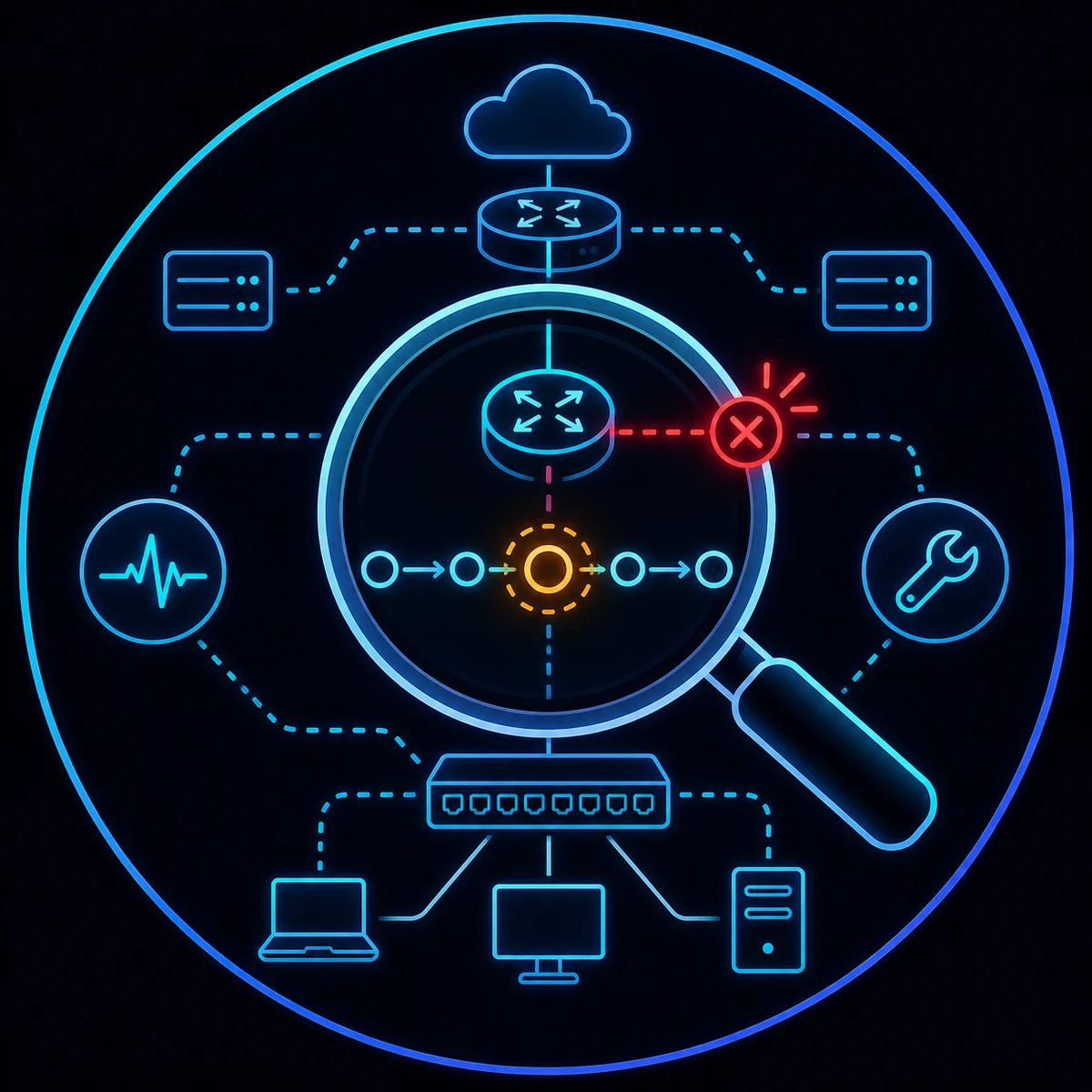
Troubleshooting Labs
PROBranching incidents with realistic BGP tables, OSPF neighbour output, traceroutes, and OSNR/OTDR degradation scenarios for optical roles. Work through the fault, state your hypotheses, narrow the fault domain — exactly like a production incident, with a score at the end.
Speech Feedback
Every voice answer is scored for filler words per minute, hedging language, pace, and trailing endings. Numbers on the habits most engineers ignore until they are on camera in front of a panel — and it is too late.

Daily Depth Drill
One question per day targeting your weakest concept area — prerequisite concepts checked so you're never dropped into something that assumes knowledge you haven't built yet. Diagram questions rotate in automatically: trace a packet through a BGP topology, identify an OSPF fault, reason through a VPC routing issue. Answer by voice or text and get a full scored breakdown with a model answer.
Routing Lab
Sharp+A BGP table or OSPF neighbour output with 2–3 planted faults. Name each error, explain the root cause, and propose the fix. Scored on diagnostic accuracy, reasoning quality, and impact assessment.
From engineers actually using it
What beta testers are saying.
“Three weeks of practicing with My Next Hop and I walked into my interviews more confident than I've ever felt. It's one thing to know the material — it's another to have actually said it out loud, under pressure, enough times that it stops feeling scary.”
Victoria Matthew
Reconciliation Engineer, Huawei Tech
“I tried the Mock Interview thinking I was ready. I wasn't. A couple of follow-up questions in, and I realized how far behind I actually was — which was exactly what I needed to see before the real thing, not during it. I went back to the books, and now I know precisely what to fix.”
Dami Joseph
Fiber Optics Engineer
“I'm the one interviewing candidates, not the one being interviewed — and Custom Question's interviewer mode has been a game-changer for that. I enter the exact question I'm planning to ask, and it gives me the model answer plus the gaps candidates commonly have at that level, with follow-ups ready to go. It's made me sharper and more consistent every time I'm on the other side of the table.”
Usman Auta
Network Engineer, InfraHome Tech — Lagos
Early beta testers, quoted with permission.
Who it's for
Seven engineer tracks — one platform.
Each track is calibrated to how these interviews actually land — by role, seniority, and company target.
Mid-level / Senior
Rebuilding depth
Entry-level
Breaking in
AI Infrastructure
Emerging role
Optical / Transport
Specialist track
Network Security
Specialist track
AI Infra Security
Specialist track
Staying sharp
Already employed
The full journey
Find your route. Get hired when you land.
My Next Hop and Japa Reality are built by the same team — Japa Reality Technologies Inc. — for two halves of the same move. One finds the way out; the other makes sure you are hireable when you arrive.

Find the routes open to you
Sponsored roles, skilled-worker visas, points-based systems, graduate routes — mapped to your finances, age, education, profession, and family situation.
japareality.com
Get hired when you arrive
Whether the offer comes before you leave or you land first and need a job fast — voice-first mock interviews and rubric-scored coaching make you hireable for the destination you choose.
Start practising freePricing
Start free. Add Sharp to stay sharp. Go Pro to sprint.
No credit card required to get started. Free accounts get 3 daily drills, flashcards, and voice speech metrics. Sharp adds unlimited drills and all specialist tools. Pro unlocks the full voice-first Mock Interview.
Every account starts with 14 days of Pro, free
Try Mock Interview, Routing Lab, Design Bank, and every other mode — no card required — then subscribe to keep Pro, or stay on the free tier.
Free
$0
Forever free, no card needed
- 3 drills per day
- Flashcard review (spaced repetition)
- 7-day progress tracking
- Voice answers with speech metrics
Sharp
$20/mo
or $180/yr (save 25%) · NGN via Paystack
- Unlimited drill submissions
- Routing Lab & Design Bank
- Behavioral Prep with STAR scoring
- Readiness score — know when you're ready
Pro
$59/mo
or $135/qtr · $500/yr · NGN via Paystack
- Everything in Sharp
- Voice-first Mock Interview with Betty
- Troubleshoot Sim — incident methodology
- Incident Call Sim — stakeholder pressure
USD via PayPal · NGN via Paystack · Cancel anytime.
FAQ
Have questions?
Is it free?+
Every new account starts with 14 days of full Pro access — no card required. After that you settle onto the free tier automatically (3 drills a day) unless you upgrade to Sharp ($20/mo) or Pro ($59/mo).
Can I practise by voice?+
Yes — the Mock Interview with Betty is fully voice-first: she speaks, you answer out loud, and she follows up on what you actually said. Every voice answer is scored on 9 speech metrics, from filler words to a confidence-signal score.
How does the mock interview work?+
Betty speaks your first question; you answer by voice, no typing. She follows up based on what you said — skip a trade-off and she asks about it. At the end you get a full scorecard, calibrated to the company and level on your profile.
Can I try it without creating an account?+
Yes — message Betty on WhatsApp for one free practice question: no signup, no install, no card. She asks your target role, asks a real interview question, and gives honest feedback on your answer.
The reps do not build themselves.
Create an account. Pick your level. Answer one question. That is how it starts.